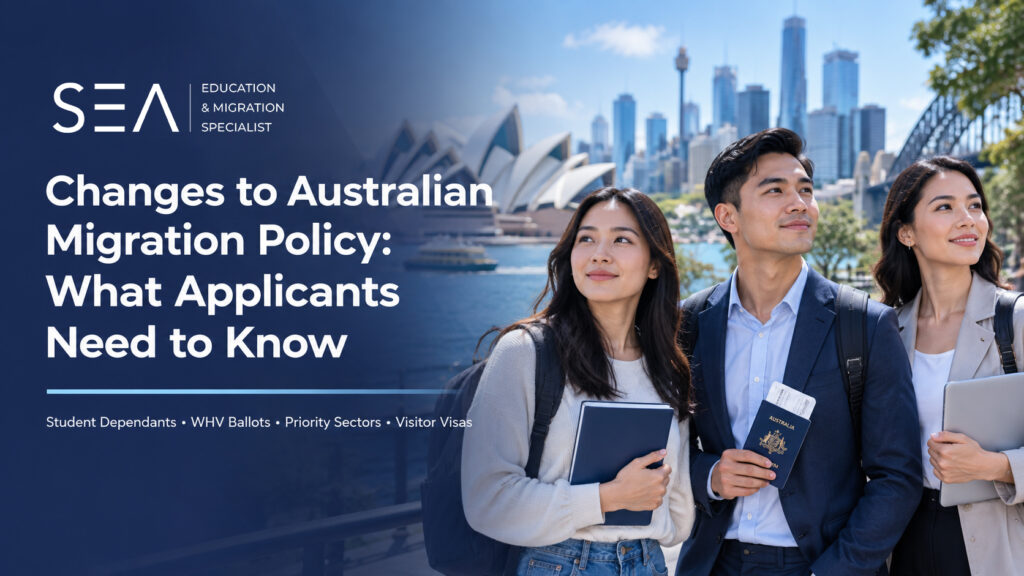
The Australian Government has announced a range of proposed changes to migration policy, including tighter rules for student dependents, a new ballot system for second- and third-year Working Holiday visas, stronger visa compliance measures and a greater focus on occupations supporting Australia’s housing, infrastructure and essential services.
Some announcements may require legislation, legislative instruments or further administrative guidance before they take effect. Applicants should not assume that an announced policy change automatically applies to their visa application. Australian migration law is complex and changes regularly, so professional advice should be obtained before making decisions about study, work or visa applications.
Student visa changes
The Government has announced that most international students will no longer be able to automatically include a spouse, de facto partner or dependent children as secondary applicants on their student visa.
There will be exceptions for certain students, including eligible nationals from Pacific and ASEAN countries and PhD students. The precise scope of these exceptions, including the relevant countries and commencement arrangements, should be confirmed once the formal rules are released.
Families already in Australia as dependents are not expected to be separated solely because of this announcement. The Government has indicated that family members already attached to a visa and already in Australia will generally remain in Australia under their current arrangements, unless they later become eligible for another visa or permanent residence.
This change may affect families who are considering relocating to Australia with a student visa holder. Before enrolling, families should carefully assess:
Course downgrades
The Government has also announced measures aimed at stopping “visa hopping” and reducing the misuse of student visas.
Students who want to move from a bachelor’s degree to a lower-level vocational education and training course or TAFE may be required to lodge a new visa application before making that change. This means students should choose their course carefully and ensure that the proposed study plan is genuine and suitable for their circumstances.
A course change may have consequences for:
Students should obtain professional advice before changing from a higher-level qualification to a lower-level course.
Working Holiday Maker changes
The Working Holiday Maker Program is expected to return to more stable processing arrangements, with the Government announcing a target of approximately three months for processing Working Holiday Maker applications.
However, applicants seeking a second or third Working Holiday visa will face a new ballot system.
| Application | Regional work requirement | Proposed ballot places |
| Second Working Holiday visa | 88 days of eligible regional work | 45,000 |
| Third Working Holiday visa | Six months of eligible regional work | 5,000 |
The existing regional work requirements will remain. Completing the required work will make an applicant eligible to enter the relevant ballot, but it will not guarantee that the applicant receives a place.
The Government has stated that the second-year ballot will be capped at 45,000 places and the third-year ballot at 5,000 places. For context, the Government indicated that approximately 57,000 people qualified for the second-year cohort and approximately 31,000 qualified for the third-year cohort in the previous year.
Applicants should keep detailed evidence of their specified work, including payslips, employment records, contracts, dates, duties and work locations. Eligible work must meet the applicable rules at the time of application.
Visitor visa restrictions
The Government has announced that a No Further Stay condition will be attached to visitor visas. This condition is intended to ensure that visitor visas are used for genuine short-term visits rather than as a pathway to remain in Australia and apply for another visa from within the country.
A No Further Stay condition can prevent a person from applying for visas. The only exception being protection visas while they are in Australia. The Department states that waivers may be available only in limited circumstances.
Visitors should therefore check their visa grant letter and visa conditions in VEVO before travelling or making plans to apply for another visa onshore.
This change may be particularly important for people who are considering:
A protection visa is not a general method of extending a visitor’s stay. It is intended for people who genuinely face a real risk of persecution or significant harm in their home country.
The Government has also indicated that people applying for partner visas from outside Australia should be able to make more straightforward applications for extended visitor visas while their partner visa application is being considered. Further details and eligibility requirements have yet to be announced.
Greater focus on priority sectors
The Government has announced that skilled migration settings will place stronger emphasis on sectors considered important to Australia’s economic and social needs.
Priority areas nclude:
The Government has also indicated that trade and construction-related qualifications may receive greater recognition in the skilled migration system. This does not mean that every trade qualification will automatically receive more points or lead to permanent residence. Applicants must still satisfy the relevant occupation, skills assessment, English, age, nomination and visa requirements.The Government has announced that a new points system will be introduced
People considering a university degree or trade qualification should avoid choosing a course based only on possible migration points. A suitable study and migration plan should also consider:
– The applicant’s academic background and genuine interests.
– The occupation’s skills-assessment requirements.
– Employment opportunities after graduation.
– State and territory nomination settings.
– Licensing and registration requirements.
– English-language requirements.
– The applicant’s age and work experience.
– Whether the occupation remains eligible when the application is lodged.
Stronger action on overstayers
The Government has also announced stronger compliance action against people who remain in Australia without a valid visa
Visa holders should:
Remaining in Australia without a valid visa can have serious consequences, including detention, removal, difficulty obtaining future visas and possible re-entry restrictions.
What applicants should do now
These updates do not all take effect immediately and when they will be implemented as yet to be announced.
If you are planning to study, work, visit, sponsor a family member or apply for permanent residence in Australia:
Migration policy can change between the time a course is selected and the time a visa application is lodged. A pathway that appears suitable today may not produce the same outcome in the future.
Speak with a registered migration agent
If you are considering migrating to Australia, speak with a professional, experienced registered migration agent about your individual circumstances.
Contact Jessica Yuen, Registered Migration Agent, MARN: 2117701, for a free 15-minute assessment.
This is general information only. This article is not legal advice. Visa eligibility depends on the applicant’s circumstances and the law in force at the time of application. Some changes discussed above have been announced but may not yet be in effect.